
樹林AI
🌐

Frontier labs are spending billions. China is closing the gap. AI talent is becoming a battleground. And AGI may not look the way people expect. Our take on where the AI race actually stands in 2026.


If someone gets fired from frontier labs for performance issues, they always say career growth, personal reasons, whatever. Then the media turns it into: "They left because they're scared AI will destroy the world."
Bullshit.
Let me tell you about a Chinese movie my Shanghai friend recommended. One of the best I've ever seen (and I usually don't like Chinese movies). It's about a guy importing generic drugs from India, the pharmacy of the world, selling at $5 instead of $1,500. Same drug. 300x the price. People were dying because they couldn't afford the branded version. The guy risks jail just to sell something that actually works.
Sound familiar?
It costs >$5B to train a frontier model today. Distillation and other new methods can produce models >95% performance for ~$20M.
There’s a reason billions were poured into frontier labs, and why they burned it: the promise that those investments would return.
If it costs $5B to train a model, the unit economics have to recover that investment. APIs need to be expensive. Agents need to be expensive. Someone has to pay back those billions.
Now someone can build a model at <1% of your investment, at near-100% performance.
When an enterprise sees $50/hour AI agent vs $1/hour AI agent at similar performance, which do you think they’ll choose?
This has huge implications.
If open models collapse the price of intelligence, frontier labs may never recoup what they’ve burned.
That’s why open source is such a threat. That’s why frontier labs are shitting in their pants. And why they want it restricted.
It also explains the IPO rush, sell the story while retail investors still believe there’s a durable moat, before cheaper models make that advantage disappear.
Come on, if AGI is truly near, if self-recursive improvement is here, why are Chinese open-source models catching up such a threat? China is already constrained on AI hardware. If your AI can improve itself, why should anyone catch up?
Or is it the big pharma calling generic drugs fake and dangerous story?
Look at the hiring. Frontier labs are still hiring aggressively, at crazy salaries. Basically: progress still depends on humans, engineering, data, compute and iteration.
Plot twist: AGI is already here!!!
But it’s Weak AGI, Strong AGI and ASI are still far, far away. Stay tuned for Part 7.
Nevertheless, AI is not going to suddenly make everyone jobless overnight.
That’s the hype frontier labs need you to believe (for their IPO!)
The breakthrough could come from them. Or somewhere unexpected, like Japan 😄. Tomorrow, or 30 years from now.
Nuclear fusion was 30 years away decades ago. It’s still 30 years away today.
And the music box is stopping. (that’s why frontier labs are rushing to IPO!)
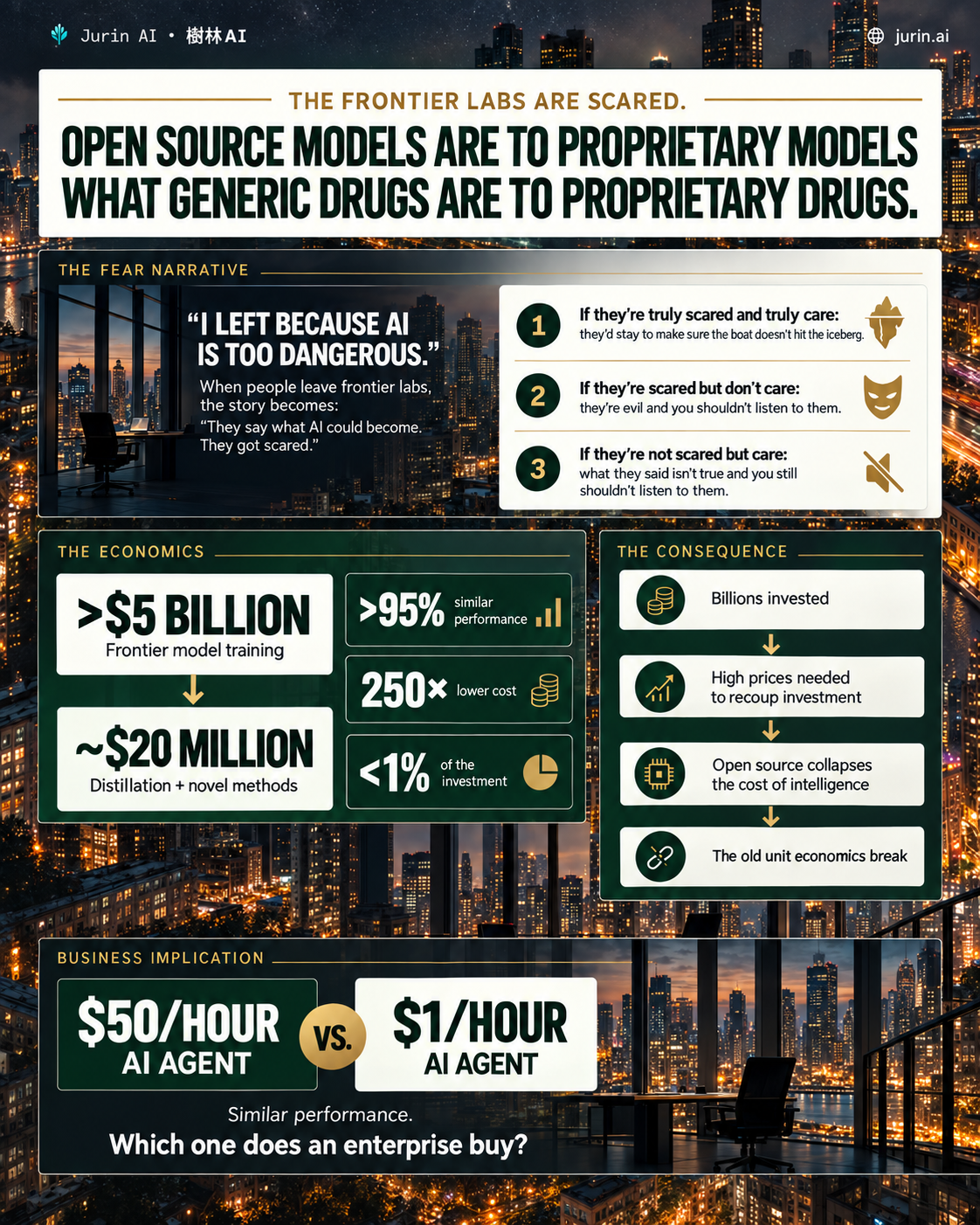
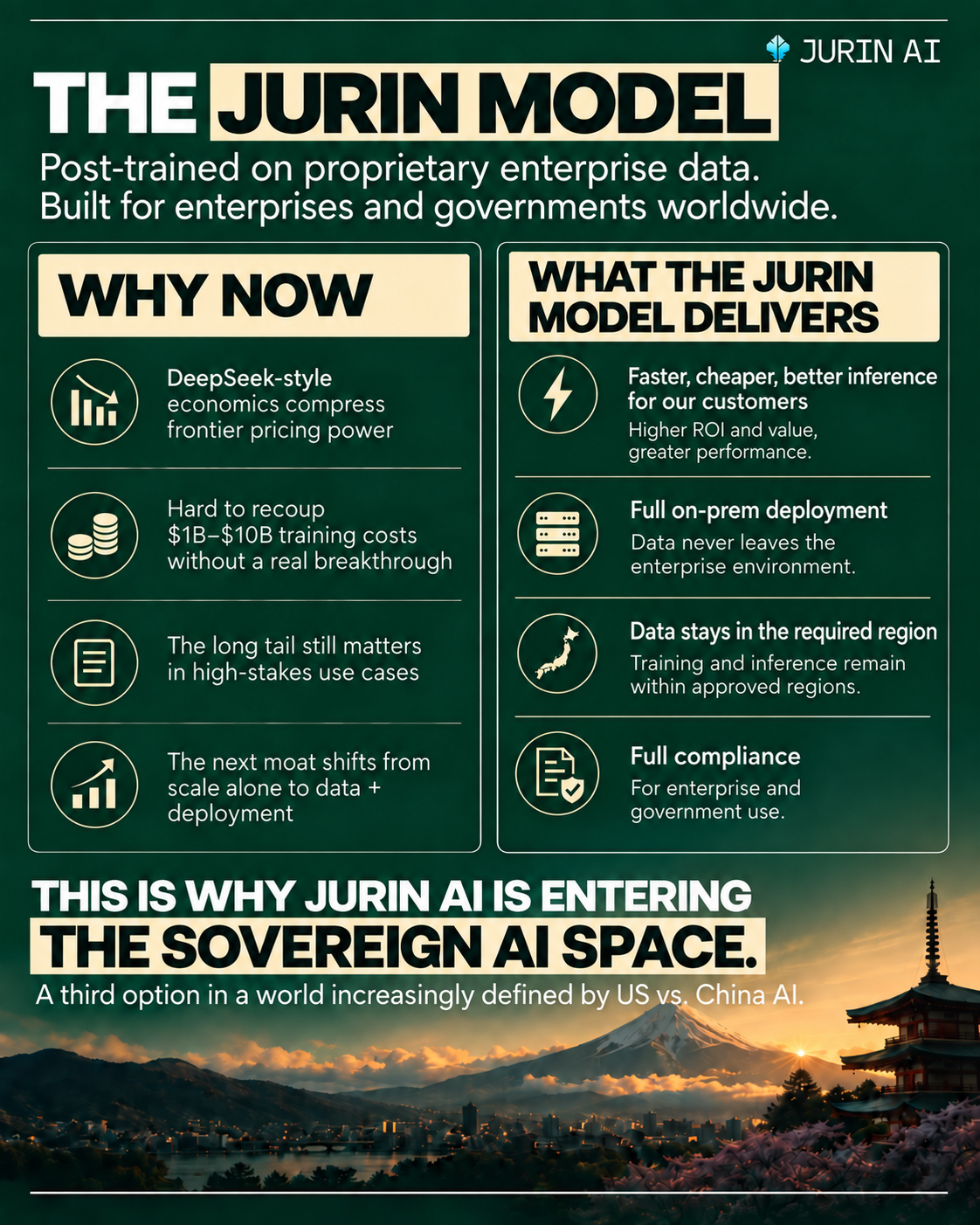
It costs between $1 billion and $10 billion to train a frontier model like GPT or Opus. There's a reason that kind of money gets poured into frontier labs: the promise is that the investment returns. By unit economics, every API call has to be expensive just to recoup that. You're paying $50/hour for an AI agent because someone has to cover those billions.
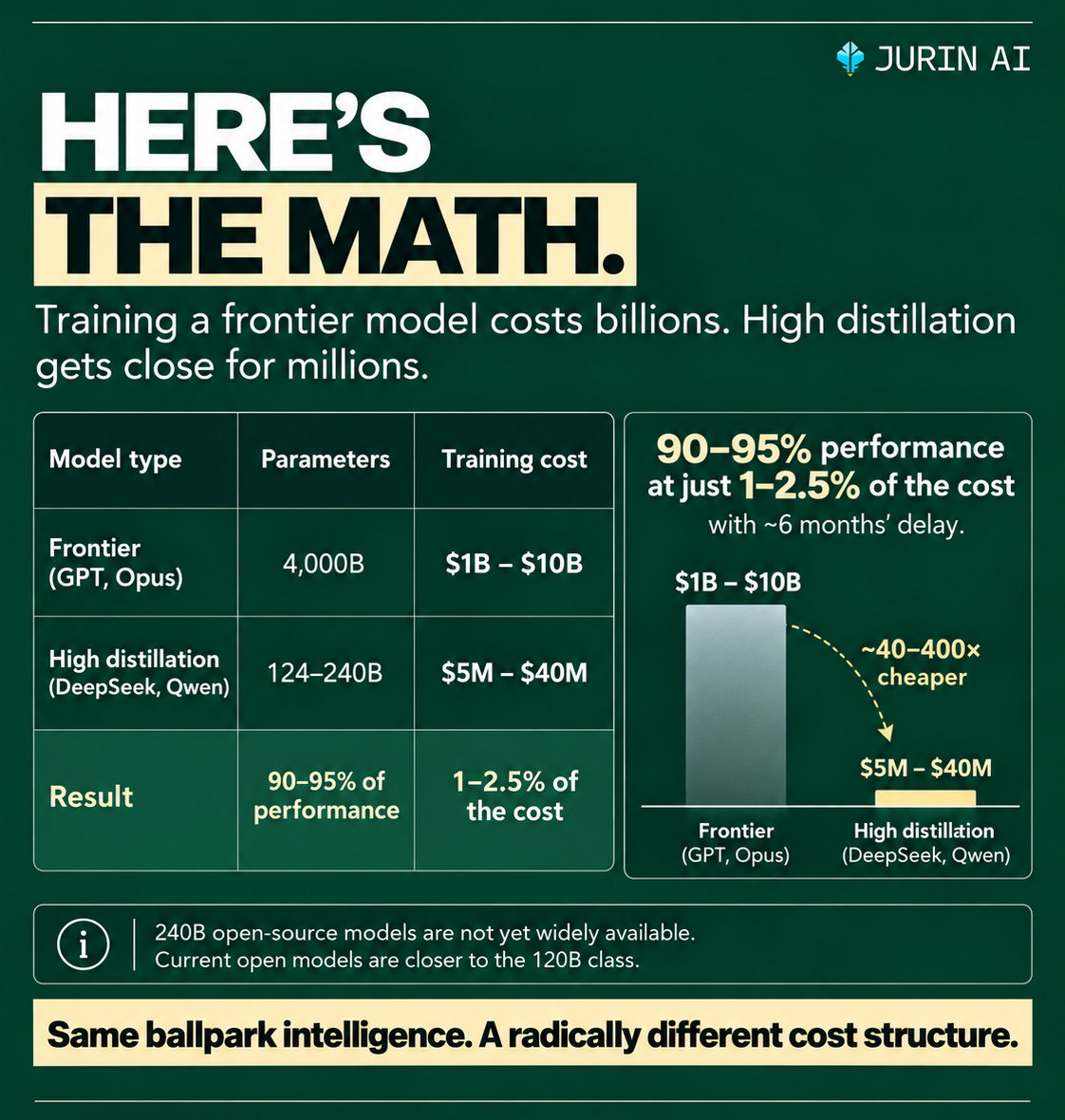
Then DeepSeek happened. Using distillation and mixture-of-experts, basically like how the human brain prunes neural connections to become more efficient, they got 90-95% of the performance at 1-2.5% of the cost. With a ~6-month delay. That's $20 million instead of $5 billion. 250 times cheaper.
When an enterprise is choosing between a $50/hour AI agent and a $1/hour one at 95% the same performance, they’re going to pick the $1/hour one every time. There is no way frontier labs can recoup their losses against that math.
Meta moving into AI compute rental means open source models are winning. Not just the frontier labs feeling the pain, it's NVIDIA and the entire Big Semiconductor industry.
Now the obvious question: is 90% good enough?
AI isn't like pharmaceuticals with heavy regulations. It's more like the generic drugs situation from yesterday’s post: unfair to the initial drug makers who invested billions, but also immoral to charge prices that normal people can't afford. Sick people desperately need the drugs to survive. The generic is the hero.
But: is 90% enough?
In human-critical situations, no. Self-driving cars at 99% safety still means 1 in 100 lane changes causes an accident. The long tail is exactly why we still don't have good self-driving.
In AI we can always say "AI can make mistakes". But is that disclaimer good enough? I think it is. Japanese enterprises, with their extremely high expectations and low risk tolerance, are a harder sell. But even they are coming around.
The frontier labs cannot recoup their costs unless they hit the next real breakthrough. 0% hallucination, complete initial AGI. Until then, the music box is stopping.
The near future belongs to Chinese open source models. GLM, Seedance and other Chinese models have already surpassed OpenAI and Anthropic in certain areas at a fraction of the price.
The long future probably belongs to Google (Gemini + Gemma + vast index database). I find myself reading Gemini more when Googling. Googling isn’t dead.
Read on where I'll talk about post-training, proprietary data, and why the frontier model itself is no longer the moat.
And towards the end we will discuss how AI startups outside the US and China will still make money. Essentially, Japanese companies like Jurin AI can still contribute deeper to the world.
The world is big and full of opportunities!
Never give up, my friends!

... and that's why frontier AIs will not get significantly better and take over the entire world.
Every major lab is scraping the same internet. The same books, the same papers, the same forums. When the inputs converge, the outputs converge.
If everyone is training on the same data, why would anyone pay more for one model over another?
The next wave of AI advantage is post-training on proprietary data nobody else has.
Data from real enterprise workflows, real B2B communications, real operational processes happening inside companies every single day. The kind of data that doesn’t exist in any public dataset… which makes Jurin’s data super, super valuable.
This is where post-training comes in.
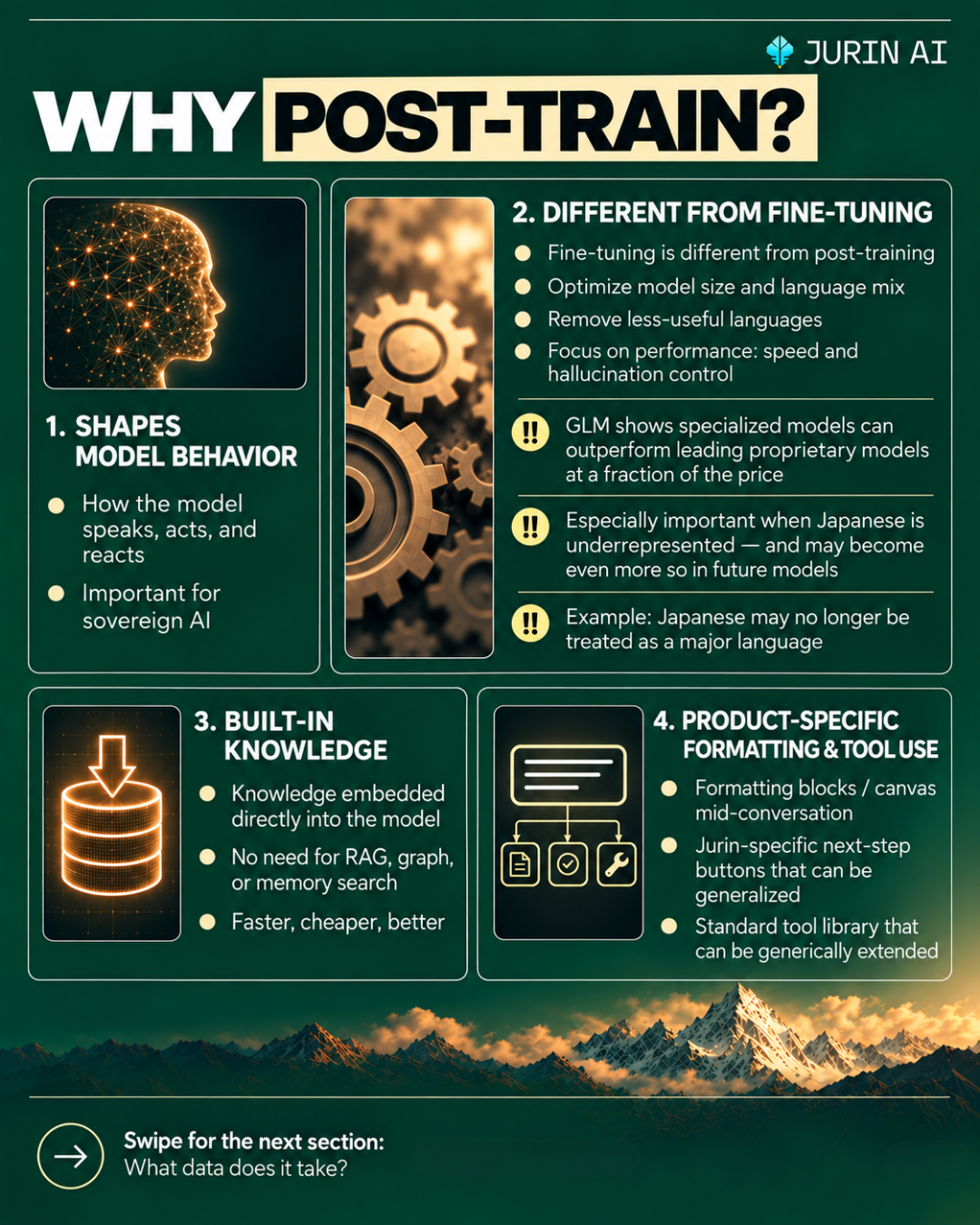
Why post-train?
→ Small models that are post-trained with proprietary data etc. would outperform large generic models.
→ Major labs are underrepresenting Japanese in their training data. It is now underrepresented, and it's just going to get even more underrepresented in the future. Models post-trained on Japanese enterprise data will have a big edge that will continue to grow over time.
→ Knowledge is embedded directly into the model. No need for RAG, graph search, or memory lookup. The knowledge is just there. Even faster, cheaper, better performance.
→ Special formatting and tool use. Like how ChatGPT and Claude have formatting blocks and canvas mid-conversation. Jurin-specific next step buttons. A standard tool library that can be generically extended. Things that make an AI agent actually useful inside a real company.
GLM, the Chinese model, already surpasses OpenAI and Anthropic at a fraction of the price in certain domains. Because they post-trained on data the US labs don't have. Same logic applies here.
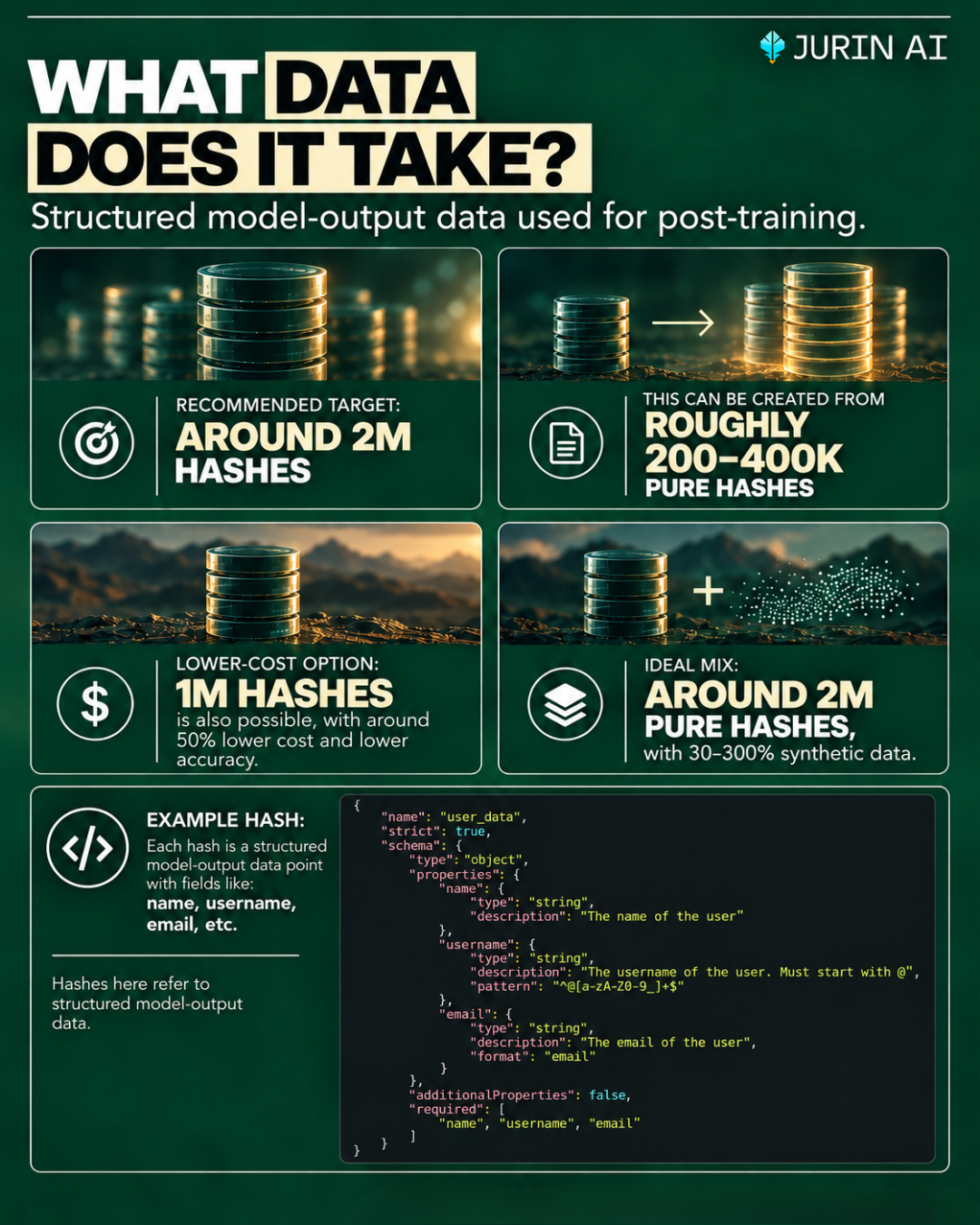
See the infographic for the full post-training math and what it actually costs to run.
Most enterprises can train around ~10 smaller, application-specific AI models to automate ~90% of their white-collar workflows. This is already what many Jurin AI customers are doing today.
Training these models costs about $250K per year, and they need to be continuously retrained and updated. But if automating 90% of those workflows replaces the work of 10,000 employees, that’s ~$10M in annual savings.
In this case, the Jurin AI contract costs only $3M per year, with training and operations fully included.
That means ~$7M in net annual savings! Plus improving customer satisfaction, increasing employee satisfaction, unlocking additional revenue and growth, and helping solve labor shortages and hiring constraints.
Cheaper AI doesn't mean less AI. It means more people using AI everywhere. The music box is stopping for the frontier labs, but a completely different kind of music is just starting!
This is why Jurin AI is entering the Sovereign AI space.

Will there be one winner or can both win?
Most importantly, where does Japan fit into all of this? (stay tuned till the end for the answer!)
Earlier I discussed the economics between US AI and China AI. But if money is not the constraint, and for both superpowers it isn’t, what actually decides the AI race? What is it going to look like for the next few years?
Disclaimer: first of all, the state of the AI race keeps changing, so the actual statistics I share will become outdated very quickly. It can even be outdated in DAYS! Also I try to share only facts, not politics. I am non-political on both US and China. My personal agenda is for Japan to have great relationships with the US, China, and the rest of the world.
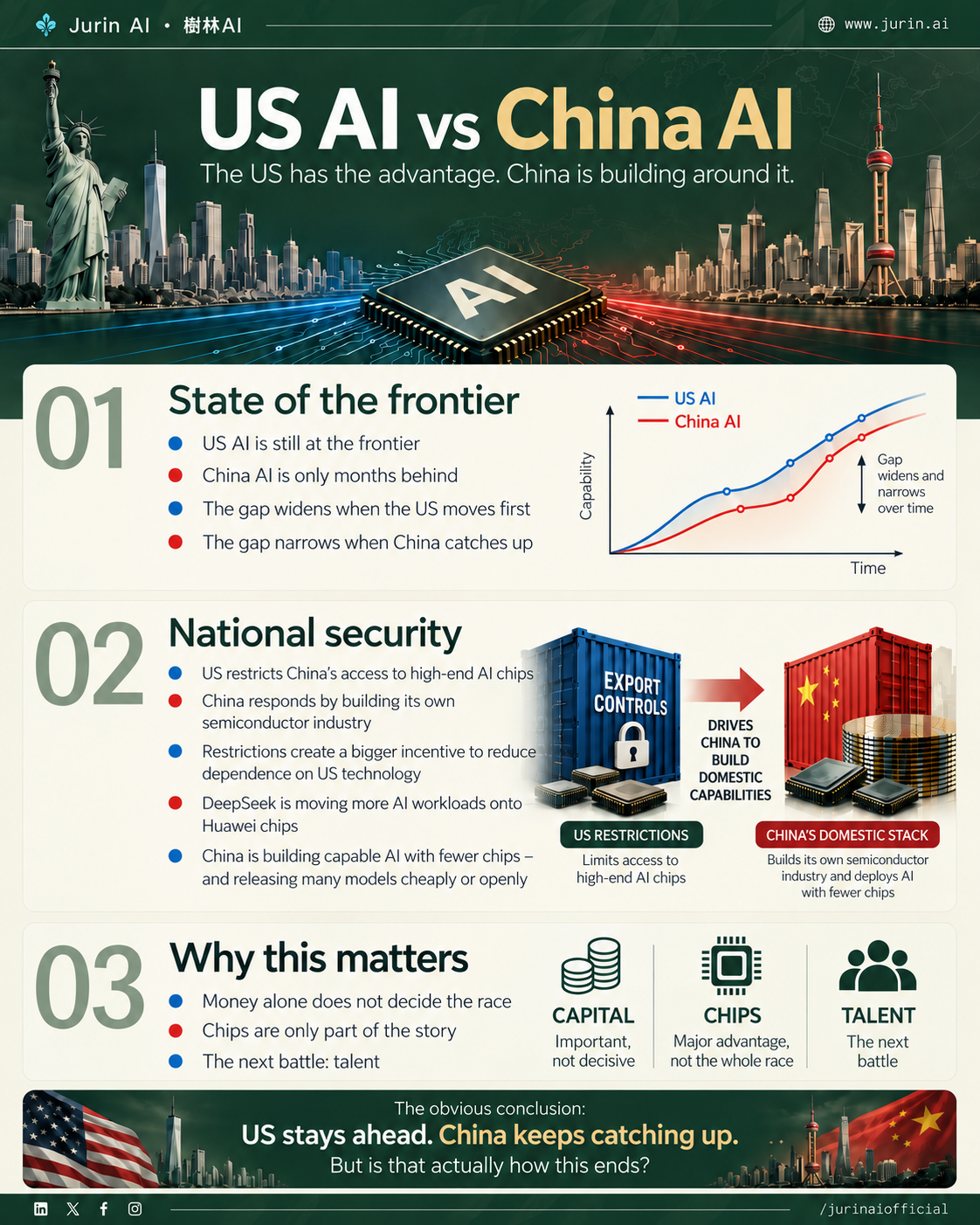
State of the frontier:
→ US AI is at the frontier, but China is not far behind
→ China AI was 6 months behind, then 7 months (gap widened), then 4 months (gap closed)
→ US AI a few days ago as of writing this this post just released new models, gap is now larger than 4 months
→ China AI is going to release new models soon too, gap will close again
National security:
→ US AI restricts China’s access to high-end training chips, while the US itself has the best and most chips
→ China AI, constrained by fewer and less advanced chips, builds out an entirely new semiconductor industry
→ The US strategy of constraining China gave China an enormous incentive to become less dependent on US technology. The strategy backfired.
→ For example, DeepSeek is increasingly moving its AI workloads onto Huawei chips
→ Basically, China is building AI Porsches without AI Gasoline, and is giving them out for free
→ And now the US is scrutinizing and trying to ban open source models
The obvious conclusion might be that the US stays ahead, China stays a few steps (months) behind and catching up every time the US moves forward. But is it true?
Chips, money, and regulations are only part of it.
—
Sneak peek into where this is going: it won't be a winner-take-all market. US AI will win in some ways. China AI will win in some ways. Europe AI will win in some ways. Japan AI and the rest of the world will also have their own place.
The world is a big, abundant place. I'm optimistic about the future with AI. US and China will have great relationships with each other. Europe, Japan, and the rest of the world will all grow richer together.
Stay optimistic, everyone.
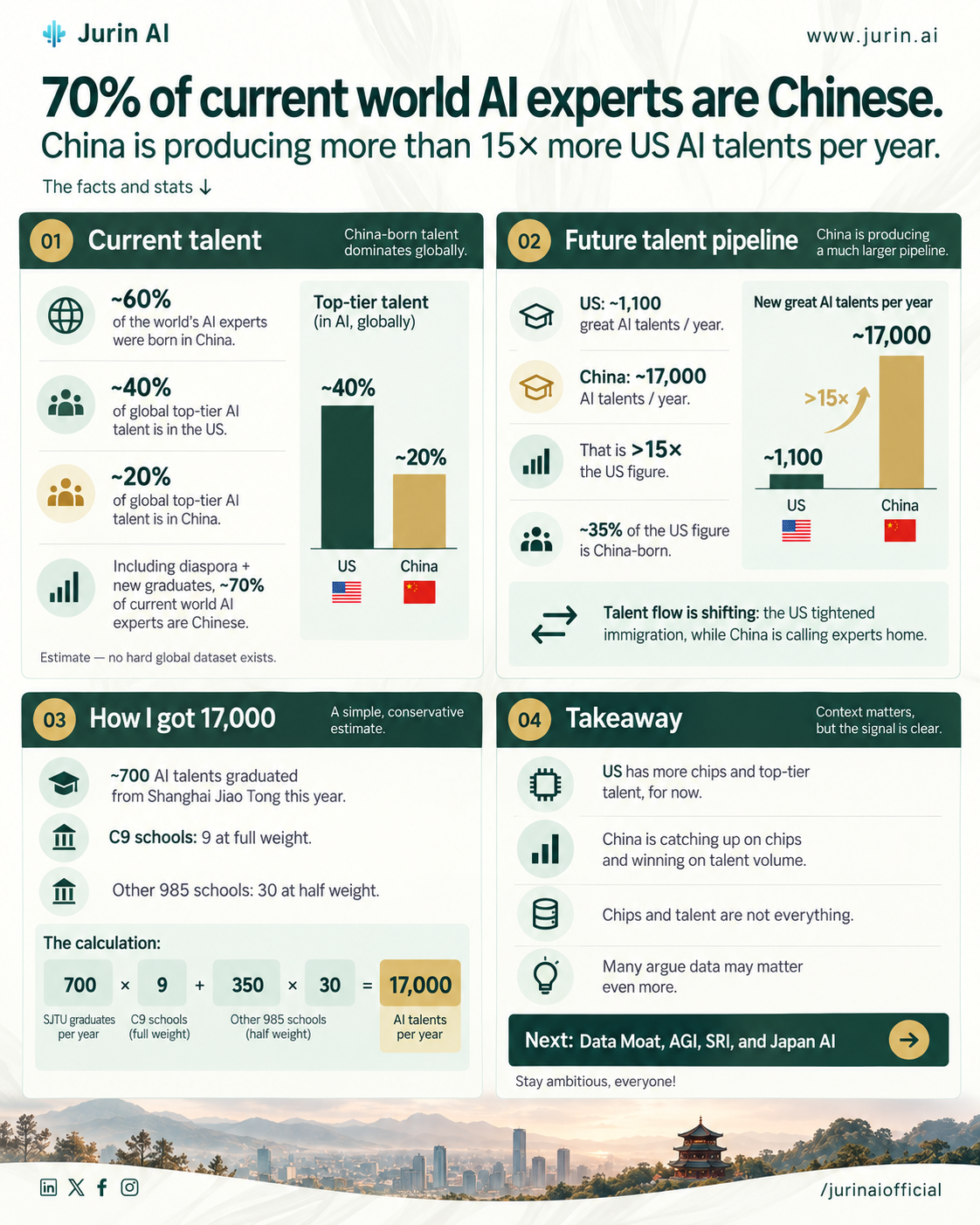
China is producing more than 20 times more US AI talents per year.
The facts and stats 👇
Current talents:
→ Beginning of 2026, 60% of the world’s AI experts were born in China, 2/3 of them (40% total) are elite published researchers living in the US and contributing to US AI. Add Chinese descendants not born in mainland China, and new Chinese grads entering the field ever year, we can safely estimate 70% of current world AI experts are Chinese (no hard data, but anecdotally it’s noticeable, stats-changing significant).
→ The US tightened immigration rules, asking experts to go back to China. China is also calling experts to return to China. At the same time China is starting to prefer China-educated experts over returnees.
→ The US still has the majority of top-tier talents at ~40%, while China has about 20%.
Future talents:
→ The US produces about 1,100 great AI talents per year.
→ China produces about 17,000 AI talents per year (estimated by Rise Ooi, me).
→ Interestingly, of the 1,100 US figure, 35% are China-born. We don’t know know how many will stay in the US and how many will return to China.
How I got the 17,000 number:
→ 700 AI talents graduated from Shanghai Jiaotong this year.
→ Shanghai Jiaotong is like the Stanford of China. (Peking is the Harvard, while Tsinghua is the MIT to me)
→ China has 9 “Ivy League” schools called the C9, and a broader group of “985” schools, bringing the total to 39 elite schools.
→ I halved the weights of the 30 non-C9 schools, even though they are still super, super good.
→ So: 700 X 9 + 350 X 30 ~= 17,000
One important caveat:
→ We have high trust and confidence in US data because we can simply get that serious AI-researchers number from top AI conferences like NeurIPS, ICML, ICRL, and so on.
→ Chinese researchers used to be super active in these international research communities. Recently they’ve mostly disappeared and are building their own communities. So all numbers are estimates, but I am confident in my estimates as I personally visited China’s top CS schools (to hire for Jurin AI) and have insider information regarding these talents.
Summary:
→ US has more chips and talents, for now.
→ China is catching up on chips, and is producing an overwhelming amount of talents.
→ But chips and talents aren't everything. Many argue data is the most important factor of all, even more important than chips and talents!
—
Sneak peek: as mentioned earlier, it won’t be a winner-takes-all market. The world is large enough to support many large and small AI companies specializing in their own niches, just like how it’s not just Microsoft and Google, but also many, many other tech companies.
Stay ambitious, everyone!
AGI is already here. It's a fact. We are now in the Recursive Self Improvement era.
RSI means AI now designs, codes, and trains its own successors. AI building AIs. Since US AGI is already here, US AI has essentially just started RSI, and even without doing much, it will get significantly better on its own.
But China AI hasn’t lost, because AGI is just dumb AGI and there’s still a long way to go to smart AGI, and eventually ASI.
→ First of all, the definition of AI is in its name, artificial intelligence. Any intelligence that isn’t human or biological is artificial intelligence, dumb or smart.
→ If you have an AI that can effectively do most human work, even if it’s still dumb, it’s AGI.
→ If you have used the expensive paid versions of the latest US and Chinese AI, well, they can effectively do everything almost perfectly. The insider frontier models are even better and we can comfortably say: AGI is here, humanity has achieved AGI in 2026. And US won the first AI race.
But earlier I shared some crazy facts:
→ 70% of serious AI experts in the world currently are Chinese.
→ The US produces 1,100 AI talents per year, 350 of them China-born.
→ China produces 17,000 strong AI talents per year, and thousands more if you look away from the top schools, and internationally.
→ The US leads in chips, but China is catching up fast.
Even though the US won the first race in AI achieving the initial AGI, not all AGI is built the same. Just like what we learned at university mathematics: Infinities are not built the same. Some Infinities are bigger than others, as they just simply grow faster.
→ US reaches first state of AGI and started RSI, with a self-growth unit of, say, 1 per year.
→ China will reach AGI in months from now and, with constrained chips and so on, will have a less than 1 unit of self-growth.
→ However, RSI is not the only factor in growth speed. Chinese has so many new talents and ideas that they essentially affects the growth factor.
→ RSI means the improvement is limited to the current model improving itself. But you can also effectively imagine Chinese talents as AI models, but even smarter in some ways.
→ Essentially: the US RSI is like a super genius CPU (frontier AI model) supported by 10,000 great talents GPUs to build the next genius; but Chinese RSI is like a super genius CPU (frontier AI model) supported by 100,000 great talents GPUs to build the next genius.
The future is still up for grabs.
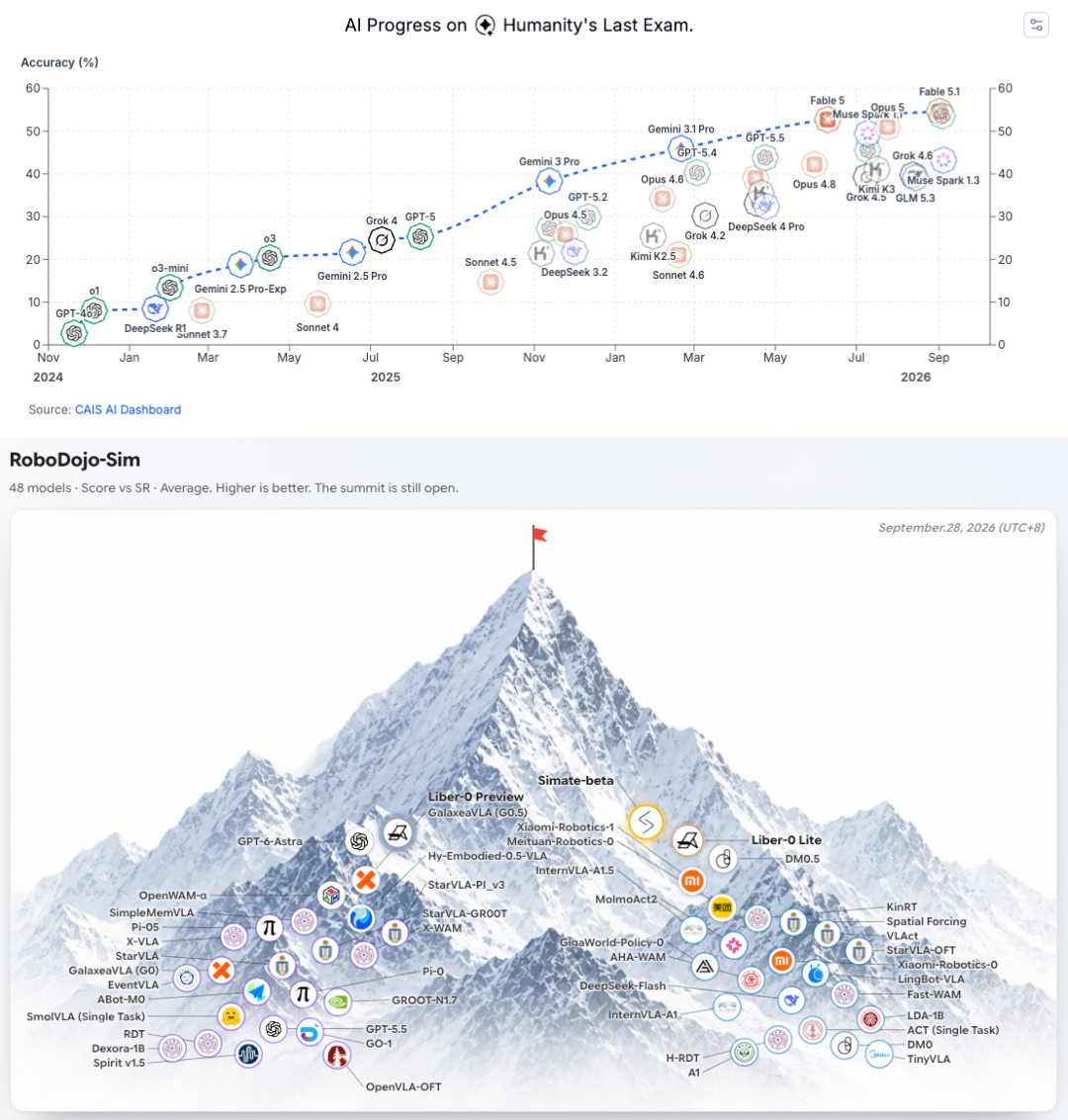
Look at the super cool-named benchmark called Humanity’s Last Exam. AI grew from 2% to 55% percent in 24 months. Whether we hit 100% in 48 months, or we hit an S-curve, we don’t know. Although not perfect, RoboDojo-Sim has a super cool mountain-pictured benchmark, showing growth from <1% to 33% within just 24 months, and the summit is still open for Physical AI.
In the next section I will revisit the path from Weak AGI to Strong AGI, and ASI.
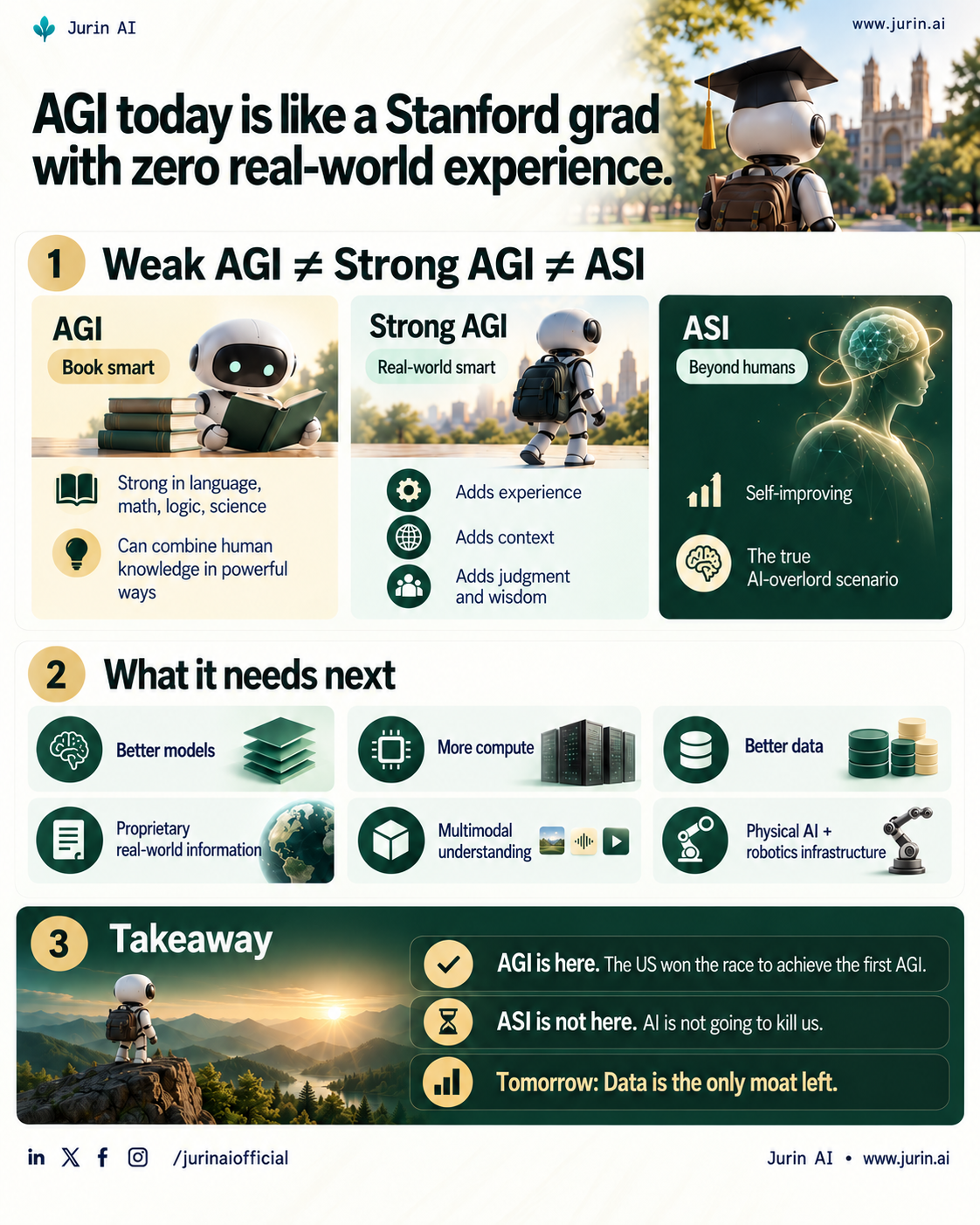
That’s AGI right now.
(Yes, AGI is already here. The US won the race to achieve the first AGI, that is a fact. Read the full details in Part 6.)
But if you imagined AGI as AI overlord, you’ll be disappointed. AI overlord = ASI.
A year ago I wrote about Weak AGI, Strong AGI, and ASI (link in comment). I was right.
Weak AGI means AI can effectively do everything a human can possibly do, including mix and match all human knowledge to do things humans couldn’t, like recently solving top mathematical problems and beating all of humanity combined.
But it’s book smart without street smarts. Because they have no real-world knowledge, experience, and wisdom.
It’s known that human intelligence is 60% Knowledge, 30% Raw Intelligence, and 10% Talent.
Path from Weak AGI to Strong AGI:
→ Aside from better models and compute and data, the path is connecting the AI to platforms, giving it access to proprietary, real-world information
→ LLMs only model language. But reality is not just language. Current Weak AGI has effectively modeled the realities around language, mathematics, logics, literature, science, speech.
→ Strong AGI needs a Grand Unified Model that also unifies all the other models, like Images, Videos, 3D World, Physical World Realities (mostly Physical AI and robots and understanding the real world).
→ As I wrote a year ago, it will take the physical world at least 30 years to build all these physical AI infrastructures.
Takeaway:
AGI is not what is seems. The benevolent AI dictator is not here. Current AGI is still as dumb as it looks, like a super genius Stanford grad with zero real-world experience and cries like a baby when it gets hit. But it will be super dangerous and lethal when it finally grows into a killer machine. And as much as we talk about “pacing the frontier”, we are on the path to creating something that’s more lethal than nuclear bombs and we cannot stop because of “China”.
So the only moat left before we all kill ourselves with ASI is data.
In the last section, we’ll talk about the data moat, and how outside of US and China, Europe and Japan and the rest of the world will each have their own place in the world. And the Grand Strategy of Jurin AI.
But here's what I actually believe: AI is not going to kill us. The world is going to grow so much richer because of AI and make everyone's lives so much better.
The US produces ~1,100 strong AI talents per year. China produces ~20,000. Japan produces ~100. And yet Jurin AI, a startup headquartered in Japan, will still win!
(in our own way 😉)
This State of AI series is heavily inspired by Tesla’s Master Plan. Our strategy is simple: create massive impact for enterprise customers worldwide. (Not trying to outspend frontier labs)
As we wrote in the last section, the last real moat is data:
→ Public data has largely been trained on or distilled by the US and China, while much post-2023 data is increasingly contaminated.
→ The remaining moat is proprietary data: business data, customer data, confidential reports, CRM data, internal knowledge, and everything inside private servers.
Before that, I also said that even with AGI and RSI, AI will not be winner-takes-all.
→ Small models additionally trained on proprietary private data will outperform gigantic models trained only with public data.
→ Four years ago, many thought OpenAI might become the sole winner. It did not.
→ Frontier labs will not eliminate AI startups, let alone existing businesses and jobs. (read this in the next update)
→ Beyond general-purpose foundation models lies a huge opportunity for application-specific models that are cheaper, faster, and better at their jobs, including Jev, Laya, and enterprise-specific models.
That is why Jurin AI is entering Sovereign AI (not only country-level but enterprise-level):
→ Training foundation models for enterprises and government departments worldwide.
→ Purpose-trained on highly proprietary, application-specific data.
→ Trained and inferenced in allowed regions only. Full compliance where data cannot leave the country.
→ Full on-prem deployment, so data never leaves the enterprise environment.
Other cool facts about Jurin AI Custom Sovereign Models:
→ Proprietary knowledge embedded directly into the models, much higher accuracy in customer environments.
→ Proprietary tool use embedded alongside it, removing RAG/memory round-trips and enabling extremely low latency.
→ Purpose-built models remove unnecessary capabilities, letting tiny models outperform titanic ones on intended applications.
→ AI agent cost per task down from ~$50/hour to <$1/hour, with further cuts ahead.
→ 10X speed, near 100% accuracy, near 0% hallucination, at 1% price.
→ Partnering with large data centers and have ordered our first AI supercomputer rack. (read this in the next update)
→ Plans to release models on Hugging Face and via API, new revenue streams. (also read this in the next update)
Jurin AI serves enterprises and governments worldwide as a third option in a world increasingly defined by US vs. China AI, including customers across Europe and Southeast Asia.
It’s been an open secret among Jurin AI customers that we train foundational models. But you, my readers, earned the sneak peek.
A full press announcement, with some very confidential, but super huge news, is coming in the next few weeks.
Keep running, my friends!
Jurin AI is building the AI Agent for high-performing enterprises. Our technology automates business communications (email, phone, messaging) and the workflows behind them for a better way to do business.
Within just one year of founding, we have become one of the fastest growing startups globally. Jurin AI is a multinational corporation with presence in Japan, Korea, Singapore, United States of America, United Kingdom, India, Malaysia, Thailand, Indonesia, and more. Trusted by large Japanese enterprises every Tokyo resident relies on and respects, Jurin AI integrates seamlessly into existing tools and systems to execute tasks across 100+ languages, enabling teams to tackle labor shortage, focus on strategic, high-value activities, and finally unlock scale to grow the business by another 10x.
メールアドレス
press@jurin.ai


