Cy is a UX designer at Jurin AI. He spent eight years at Microsoft, interning there, graduating into a full-time role, and designing Microsoft Loop before he decided it was time to go.


Cy started out as a graphic designer. Like a lot of young designers, he had ideas about where that would go.
"As a young designer you have a lot of ideals about what you want to do. Maybe become a famous designer or whatnot."
He shifted his focus to UX, found he genuinely enjoyed it, and ended up at Microsoft. Eight years passed. Health issues. COVID. For about six years life was largely on hold. When things started to clear, he looked around and realized nothing was keeping him where he was anymore.
"I never really planned to be around that long. Eight years is a long time. When they offered me the five-year paperweight that everyone freaks out over, I never took it. But as soon as they said I was going to get my tenure ones, I was like, okay, now it's just time to leave."
He quit, moved to Japan, and decided he would find a job after he arrived.
Cy had been studying Japanese during COVID, taking tutor classes for about a year and a half. Some parts were easier than he thought.
"When I was younger, like below 11, I was consuming a ton of Japanese media. All the Godzilla movies. So the pronunciation was never really hard for me. But conversational, I just forced myself to speak it every day."
His view on language learning is simple: classes help, but they are not enough.
"You can only study so much. You learn maybe 20% in class. The other 80% is just using it every day, committing it to muscle memory to the point where you don't have to think about how to say something, you just think about the answer."
While settling into Tokyo, he picked up freelance UX work to stay active while taking Japanese classes.
When the freelance work wrapped up, he started looking for his next full-time role.
Most of the interviews Cy had in Japan did not make him excited.
"The interviews are boring and the products are boring. I was taking senior designer position interviews and they're asking me if I can make a PowerPoint. Japanese app design I just don't think is very good, everything is Japan-first made but retrofitted for outside Japan. I just was not interested in any of the products."
Then a recruiter introduced him to Jurin AI. His first impression of Rise was intense.
"I remember feeling pretty intimidated, like, yeah, no social life for two years, you're going to be in it. I really thought hard about the commitment I wanted to make. At that point I just thought he was an intense dude being a little strong-handed for no reason. Now I understand things a bit more."
What made Cy say yes was the product.
"When Rise showed me the demo, it was still very rudimentary, not what it is today, but I saw the direction it could go. As a designer I knew I'd have a lot of control over that. I thought, okay, this is something I could actually have fun working on."
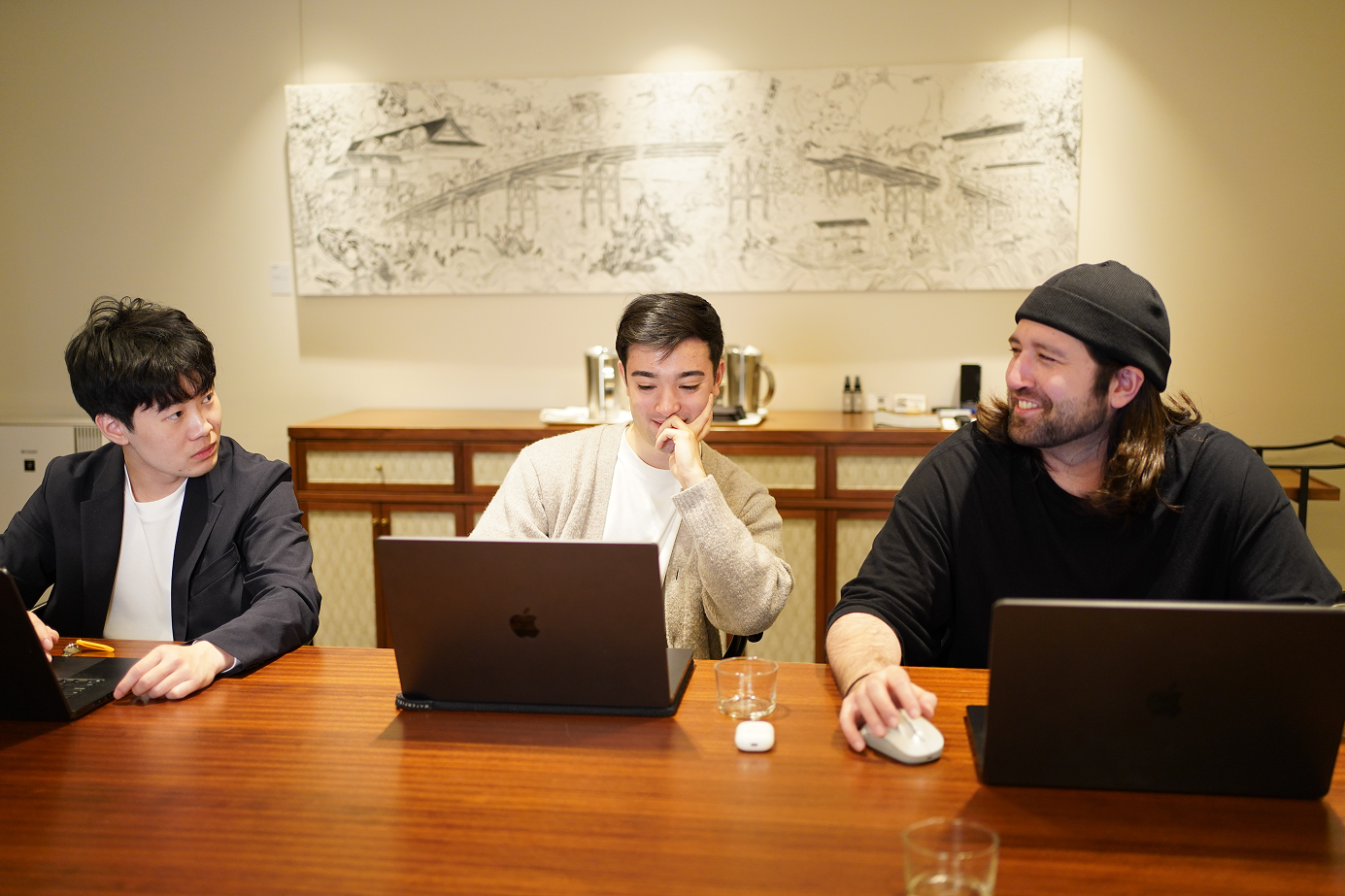
For Cy, his work is constant and iterative.
"It's like speed dating. All the questions that come in during work are tricky but they're all these little nuggets. Okay, let's figure out this problem, we spend five, ten minutes, figure it out, then the next question comes in. It's iterative. I don't feel like there's one huge daunting question I'm sitting with. It's just figuring things out one by one."
The design studio process runs the same way.
"We come together with some initial designs, tear them apart, iterate on that, and eventually get to the point where we feel good about something. Then it gets to the engineers. As I'm communicating to the engineers, the next topic is already starting. It's continuously overlapping."
Jurin AI is still moving quickly, so the product is not built by waiting until every idea is perfectly formed. The work is to understand the customer problem and decide what actually belongs in the product.
"We need to decide what they need and not what they want, not the stuff that they ask for but the stuff that would be in the product that would make sense. We consider multiple customers and then we decide if it's worthy of pursuing. And then we will that into existence."
The hardest thing he has been willing into existence all year is CRM and ERP.
"The creation isn't the hard part. It's wrapping my head around all the moving parts that come with something I've never worked with before. I've been designing everything with CRM and ERP in mind for basically this entire year. We have all the parts in place, we just need to put them together now."
A year ago, Jurin AI looked very different. The first version of the app is barely recognizable compared to what exists today. Cy was there through the changes, making design decisions that are now visible in the product.
"Sometimes I think this week wasn't the most productive week. But then I look back at everything that's happened over the last year and I feel good. While things are changing you might be stressed about everything happening around you, but you look back and things have moved so far."
After eight years at Microsoft, Cy had only two projects that he could actually show in his portfolio. Everything else was either under NDA or never shipped.
"At Microsoft the area of ownership is very small. When I finished at Microsoft and put together my portfolio for job hunting, when I look back and tried to piece things together it felt so minimal. I have these two projects I can show and everything else is either under NDA or work that never actually shipped. Already in the last year everything I've done in Jurin, if I were to put it in my portfolio today it's already so much more. All the decisions I made are actually in there. Having that sense of ownership feels really good, I didn't really have that up until this point."
The company’s growth has also made ownership easier to sustain.
"I feel good now because the company is also larger, everything's divvied up a lot more. You have more hands on everything."
One thing Rise says often has stayed with Cy: If I could do your job, why would I hire you? Cy thinks about it a lot as a designer.
"Always find the person who can do something you couldn't do yourself. If I'm a designer and I want to work on a website, I need to find someone who's better at coding than I am. At a smaller company it's a lot more apparent, if you have individuals that can do the job of maybe five people, you don't need five people to do the job."
Cy is direct about the type of person who does well at Jurin AI.
"If you coast and don't put in the extra effort, at a bigger company nothing's really going to fall on you, there's so much leeway and padding. At Jurin that isn't going to fly. Everyone's relying on each other. Everything is always falling on everyone as an individual. If you have a lot of pride in your work and just want to make sure you put out the best version of whatever you can within a reasonable amount of time, those people are going to do better here."
And for people who want something more relaxed, Cy is honest about that too.
"If some people just want a job where they just want to relax, that's just not going to work here."
With his experience, he understands why people choose big tech: the name, the pay, the structure, the scale. The important thing is knowing what you’re after.

It comes down to ownership and portfolio. At a bigger tech company you might have the Silicon Valley pay or the name on your resume, but your portfolio isn't going to develop the way it would somewhere you have real ownership. If you want to actually build your skills and hone them, smaller team, longer hours, more ownership. At the end of the day you're going to have a lot more under your belt when you come out of it. I have a lot more fun now.
— Cy Eitharong, Design
We’re hiring. Find out more at jurin.ai/career.
Jurin AI is building the AI Agent for high-performing enterprises. Our technology automates business communications (email, phone, messaging) and the workflows behind them for a better way to do business.Jurin AI is building the AI agent for high-performing enterprises. Our technology automates business communications (email, phone, messaging) and the workflows behind them for a better way to do business.
Within just one year of founding, we became one of the fastest growing startups globally. Jurin AI is a multinational corporation with presence in Japan, Korea, Singapore, United States of America, United Kingdom, India, Malaysia, Thailand, Indonesia, and more. Trusted by large Japanese enterprises every Tokyo resident relies on and respects, Jurin AI integrates seamlessly into existing tools and systems to execute tasks across 100+ languages, enabling teams to tackle labor shortage, focus on strategic, high-value activities, and finally unlock scale to grow the business by another 10x.
Media Contact
press@jurin.ai


