Ken is a senior executive partner at Jurin AI. He spent 43 years at Mitsubishi Estate, where he led the redevelopment of Marunouchi in Tokyo and Grand Front Osaka, two of the most consequential urban projects in modern Japan. He ran OCA TOKYO as its Founding Director and General Manager for five years.

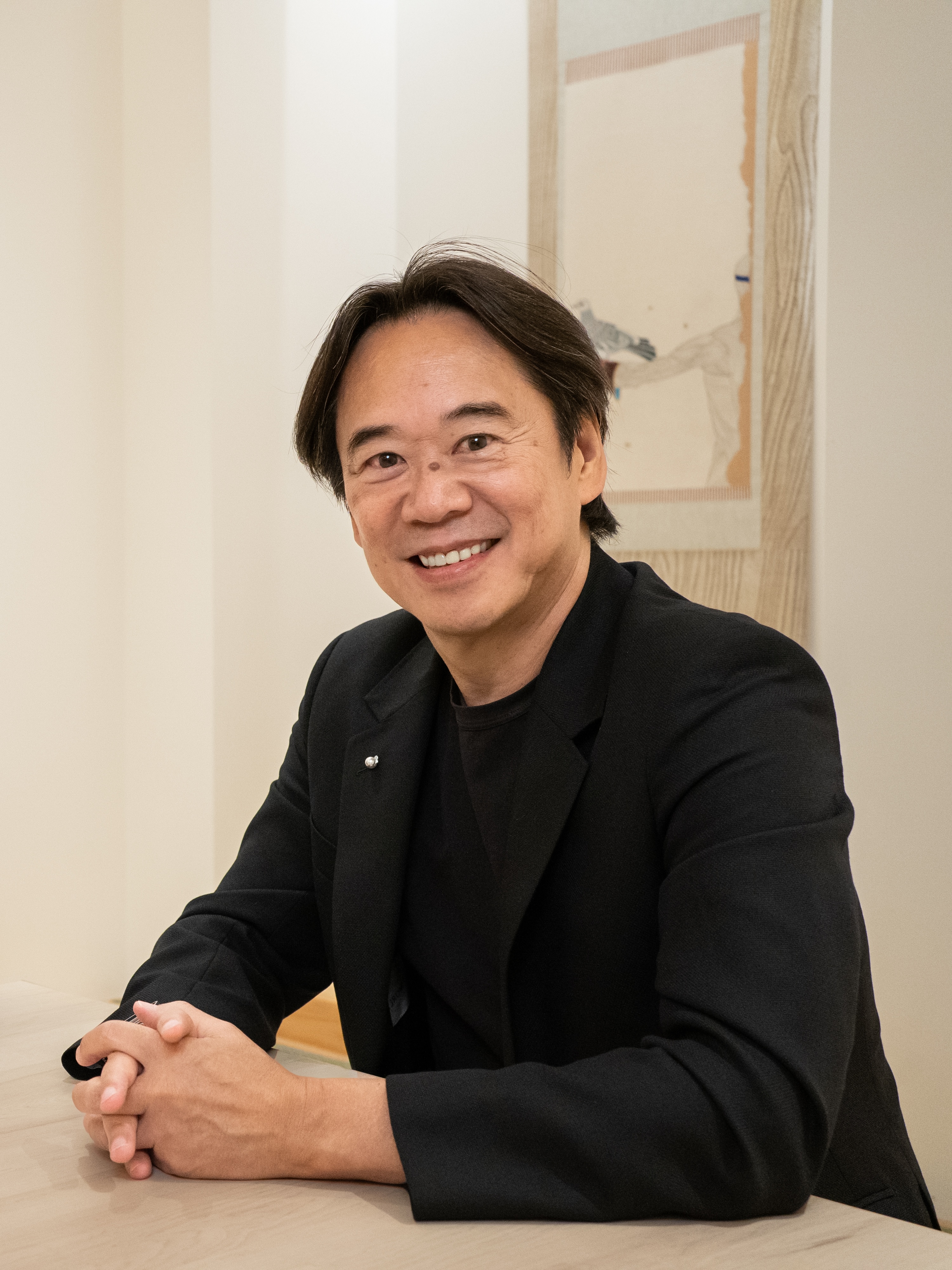
When Ken tells people he is working as a partner at an AI agent company, most of them ask some version of the same question.
Why?
He understands why they ask. On paper, four decades of city planning and an AI startup can look like two completely different careers.
"The way I see it, both city planning and AI agents are essential items for building the future. In the real world, cities serve as platforms. In virtual space, AI agents will serve that role. Eventually, the boundaries between the two will gradually disappear. For me, it doesn't feel out of place at all."
But to understand why it makes sense to him, you have to start much further back in Australia, in 1968, with a six-year-old Japanese boy who looked like an alien to everyone around him.
Ken's mother is Japanese-American, born in San Francisco. She met his father at the University of Chicago, and the two married in the United States before returning to Japan before Ken was born.
His father was a university professor and a pioneer in development economics and international development evaluation, whose work repeatedly took the family overseas. Ken spent his early primary-school years in Australia, most of middle school in Thailand, and only began living continuously in Japan from high school onward. English was the language spoken at home.
Australia was the first place where he had to learn how to operate inside a culture completely different from his own.
“To them, I must have looked like an alien who had just stepped out of a UFO. At first, they really treated me like a ‘yellow monkey.’ But even as a child, I learned that you can’t just force your own thoughts onto other people. First, you have to take in what they’re saying and accept it. Then you can say what you think.”
His family were the only Japanese people around.
“Kids can easily ostracize you. If that happened, there were no Japanese people around to help me. So I basically learned ‘never to say no.’ They had a completely different culture and completely different ideas. I learned to accept that first, listen, say ‘I see,’ and then respond with, ‘By the way…’ I feel like my basic communication skills were born there.”
A few years later, the family moved to Bangkok.
Bangkok in the early 1970s was a different kind of education. Anti-Japanese sentiment ran strong among Thai university students. The school Ken attended would close periodically when protestors from Chulalongkorn and Thammasat universities arrived with Molotov cocktails.
"Because it was dangerous, the school would shut down. As a young middle schooler, I was just happy to have the day off, though. But living in that kind of environment made me interested in society and wonder, ‘Why are things like this?’ I experienced cultural differences firsthand in both elementary and middle school, and I also experienced the dangers that can sometimes come with them."
Even food became part of the lesson. He hated Vegemite when he arrived in Australia and loved it by the time he left. The same happened with mutton. In Thailand, it was cilantro.
"I strongly felt that human values change depending on the environment. I realized the danger of clinging rigidly to one set of values. It's natural to change. So I learned to accept nature and gracefully adapt to the flow of things, while holding onto the core things I truly believe are good or bad."
High school and university brought him back to Japan for good, to Seikei in Tokyo, where his father was now a professor. His American cousins were at Stanford and Berkeley. He visited. At Berkeley one evening, he saw an enormous building blazing with light and asked what was going on. He was told everyone was studying.
“I was shocked. I was genuinely surprised by how different the attitudes toward studying were between university students in Japan and the United States.”
At university in Japan, while everyone else was caught up in the college student boom of the era, Ken was more interested in music. He was into Black Contemporary, the American genre that was moving through Japan in the late 1970s. He had two turntables and a mixer at home and made DJ mixtapes that he distributed to friends across campus. They were so well-received that he started to wonder if that was the direction his life was heading.
"I seriously thought, 'Maybe I'll become a DJ in the future.'"
He did not become a DJ.
Ken’s route into Mitsubishi Estate was not the result of a carefully mapped career plan.
A senior from his high-school basketball club worked there. Ken admired him: cheerful, decisive, the kind of person who naturally pulled everyone around him forward.
"He had great leadership, was cheerful, and pulled everyone forward. I wanted to become someone like him. Honestly, I joined the company without really knowing what they did. I didn't choose it based on a long-term career calculation."
His first assignment had almost nothing to do with buildings.
He was placed in the Information Systems Department and tasked with replacing paper-based business processes with computerized ones.
He had studied economics.
Now he was programming in COBOL.
“You had to analyze the current situation, map the entire process from start to finish with ‘Yes’ or ‘No,’ create the main routines and subroutines, and then program it in COBOL. Until then, it was normal for me to think about things in gray areas. This forced me to divide things into black and white, structure them properly, and assemble them. I think that developed my logical thinking enormously.”
It was demanding work.
“The more I built, the more bugs inevitably appeared. I pushed myself so hard that I developed scintillating scotoma. From extreme stress, my vision would start flickering. That’s how far I pushed myself.”
That intensity was part of a philosophy Ken carried through the rest of his career.
“If you put in 120%, you’ll properly get a 120% return. I tried desperately to figure out how to make things happen. If I still couldn’t after doing everything I could, then so be it. But most of the time, I was able to achieve what I set out to do. I’ve lived my life by looking at things positively and pushing forward.”
“City planning is about creating spaces that generate profoundly moving encounters between people, things, and events.”
Making those spaces possible, in his experience, takes three kinds of people.
Yosomono. Outsiders, who bring ideas unconstrained by existing assumptions.
Bakamono. Fools, willing to take risks other people consider unreasonable.
Wakamono. Young people, with enough energy to keep going.
Ken needed all three during the redevelopment of Marunouchi.
"Just like the old Regain energy drink commercial song that went, 'Can you fight for 24 hours?', we were at the office every single night until 2 or 3 AM, went home, and were back at the office by 9 AM. I lived that kind of life continuously."
His team had been studying how Tokyo’s central business district could evolve into something much denser and more globally competitive. One early proposal became known as the Manhattan Plan: dramatically increasing the floor-area ratio of the Marunouchi district to transform Tokyo's business center into something that could stand alongside the world's great cities. At the time, demand for office space was becoming too much for central Tokyo alone, leading to overconcentration and driving up land prices. The plan was meant to help address that.
The plan was leaked before it was ready. Newspapers ran it under the name the reporters had invented. The Tokyo Metropolitan Government, in charge of urban planning decisions such as floor-area ratios, was furious.
Mitsubishi Estate was effectively shut out.
It was a disaster. For years, the team remained on the outside. They also kept studying.
“We had endured a long period of misfortune, but during that time we studied desperately. The authorities on the other side didn’t have that knowledge. The moment we finally sat down at the same table, the match was already won. The new urban regeneration plans proceeded almost exactly according to the drafts we had written.”
The Ishihara administration came to power in Tokyo in 1999 with a clear philosophy about concentrating resources rather than dispersing them. Suddenly the tide turned completely.
"I really felt how drastically things can change depending on leadership."
The work Ken and his colleagues had spent years preparing suddenly had somewhere to go.
Ken was sent to lead what became Grand Front Osaka, a project involving twelve companies with their own interests, none of which were aligned.
"Osaka was in utter chaos, and I went there fully prepared to pull the chestnuts from the fire. Everyone was just pushing their own agendas. The meetings were filled with furious arguments and nothing was ever resolved. I was suddenly dropped right into that environment."
Ken arrived with one advantage: the credibility he had built through Marunouchi. Rather than trying to force twelve companies toward the same conclusion, he worked through the idea of Area Management, which did not exist in Osaka at the time, piece by piece.
"Gradually, everyone understood and said, 'Alright, if Estate says so, let's do it.' We managed to unite those 12 companies. That was another huge turning point for me."
Near the end of his time at Mitsubishi Estate, Ken took on one more project. The company was creating OCA TOKYO, a new kind of social club and a first-of-its-kind initiative for Mitsubishi Estate. Ken became its Founding Director and ran it for five years.
"I interviewed and met a lot of different people, and it was during that time that I first met Rise."
Ken’s first impression was not exactly “future AI founder”.
"Initially, I just thought he was a very unique young guy, but he seemed to really look up to me. He would ask things like, 'I have to meet with corporate executives today and I want to get a suit made, can you give me advice?' or 'What color cufflinks should I wear?' I found him very endearing and thought, 'What a cute guy.'"
Then Rise asked if he could show Ken what he was building. There was a small room next to the gym on the fourth floor. That was where it happened.
Ken was impressed, but not convinced.
"When I first saw it, I thought, 'Oh, this is amazing.' However, when considering whether a corporation would adopt it, it was still in its very early stages. The speech was a bit unnatural or cut off at times. So I also somewhat felt, 'Ah, it's still only at this level.'"
A few months later, Rise showed him the product again.
“It had completely improved. That made me think, ‘His speed is incredible.’”
But speed was not what decided it for Ken.
“Rise’s incredibly high ambition really struck a chord with me. My own foundation has always been revitalizing Japan and showing what Japan can do to the world through places like Marunouchi and Grand Front Osaka. Rise said, ‘The FAANG companies are all American. I want to use AI to create a movement from Japan that can rival them.’ That incredibly high ambition struck a chord with me. I thought, ‘That’s exactly the same as what I’ve been doing.’”
Ken is explicit that the connection was not primarily technical.
“It wasn’t really about AI as a category. I felt that the level of our thinking and our mindset were the same. That was when I thought, ‘I want to support this.’”
When Osawa joined as Chairman, something else clicked into place.
“Mr. Osawa has solid technological expertise. I felt that if he was involved, then there was real technological confidence behind the product. That made me much more comfortable getting involved.”
When asked where he sees the most potential in the company, his answer is not technology, not product, not timing.
“Ultimately, a company is its people. Rise is someone people trust. At the beginning they didn’t have much, but everyone worked desperately to build what exists now. Because it’s a startup, there are probably still many things that aren’t perfect. But strong relationships of trust between people are vital. A company that has that is strong.”
By this point, the answer to the question Ken gets asked begins to make more sense. He does not see city planning as the business of constructing buildings. Cities are platforms: places where people, commerce, information, culture, and chance encounters come together.
AI agents, in his view, will become another kind of platform.
And there is another reason the transition feels familiar.
Before Ken ever built a city, he was building systems in COBOL.
“Because I started my career programming, the fundamental mindset of structuring and assembling things is the same. That part is very easy for me to understand.”
And after spending decades leading projects himself, he sees his role differently now.
“At this point in my life, I’m at an age and in a position where I should be supporting the younger people heading toward the future. If they are working hard, I want to properly support them. That’s why I got involved in a startup.”
“I don’t like forming a fixed idea and holding onto it rigidly. Things keep getting built while we run. Every day I discover another side of the company. I’m learning every day. It’s interesting.”
For Ken, “interesting” matters.
“Things have to be interesting to me. I can’t function otherwise. You need that excitement, because if you don’t feel it yourself, you can’t convey it to anyone else. I’m always asking, ‘What is exciting about this company?’”
Rise still gives him material.
“After meetings he’ll call me and ask, ‘What did you think? How did it go?’ He’s always asking for his own report card. That’s what I find endearing about him.”
Ken has a very specific image of what success looks like for Jurin AI. It is the same kind of success he spent his career building in physical space.
"What I definitely want to achieve is a reality where many companies say, ‘We are so glad we implemented Jurin AI.’ I want people to naturally say, ‘Oh, Jurin AI? That system is great, isn’t it?’ Even in Japan, we aren't at the point yet where people instantly associate us the way they say, 'Oh, you're the ones who did Marunouchi.' Figuring out how to get there is a lifelong pursuit."
He spent much of his previous career building that kind of recognition around physical places. Now he is thinking about how a software company earns it. Part of that is differentiation, the kind of comparison chart where competing products are lined up feature by feature.
"Jurin AI has to have something only it can do. It's not just about GPT performance or supporting 105 languages. It's the support structure, quick response, all of that combined. When laid out in a comparison chart, the number of checkmarks next to Jurin AI has to be the most."
He is also thinking about the growth question that every successful organization eventually has to face. OCA TOKYO taught him about this directly: what happens to quality and culture when a community grows big.
"Selling a packaged system in bulk is one way to grow quickly. But walking alongside each company is the most demanding. OCA TOKYO started with 32 members and now has over 1,500. Completely new people keep appearing. The question is, how do you guarantee the quality as you scale? That is something we have to work through."
On what young people should be developing as AI becomes more capable:
"Have your own opinion. And for that, you need real experiences. Go as far as possible. You can fly around the world on the internet, but the most important thing is real encounters. With people, things, and events. Human beings trust through all five senses. Online, you only have sight and sound."
The five-senses argument is not abstract for him. He grew up in places where the food was unfamiliar, the language was different, and the social rules had to be learned from scratch.
"Touch, sensation, smell. When all of these align, that's when humans really learn, and trust is born from that. So, leave the routine work to AI and spend the rest of your time flying around the world, meeting all kinds of people, having all kinds of experiences. Maybe even go to space."
The human capability he thinks is most undervalued, and most essential, is one that almost no one talks about: acceptance.
"You need the determination and readiness to accept everything. Not many people have it. People look through colored lenses and think, 'This is really how it is'. That kind of stereotyped thinking is the most dangerous. Meet everything as if it is new, as if you are meeting it for the first time. To understand what another person is really trying to say, you need the capacity for acceptance. Beyond acceptance comes gratitude. If people had those qualities, wars wouldn't happen. The most important thing is becoming a person who truly listens."
It is a skill Ken has been practicing since childhood.
Long before Marunouchi, Osaka, OCA TOKYO, or Jurin AI, there was a small Japanese boy in an Australian schoolyard trying to understand people who saw the world completely differently from him.
He learned to listen first, then speak.
Ken still has plenty he wants to do.
"My big dream at this stage of my life is to reach 100 years old in good health, with both my brain and body still functioning properly. I only have about 30 years left, after all."
And for Jurin AI, and everyone who will encounter it from here:

We are going to become a company emerging from Japan that rivals the FAANG companies and astonishes the world. So please, lend us your strength to help make that happen.
— Kenichi Hirono, Executive
We’re hiring. Find out more at jurin.ai/career.
Jurin AI is building the AI Agent for high-performing enterprises. Our technology automates business communications (email, phone, messaging) and the workflows behind them for a better way to do business.Jurin AI is building the AI agent for high-performing enterprises. Our technology automates business communications (email, phone, messaging) and the workflows behind them for a better way to do business.
Within just one year of founding, we became one of the fastest growing startups globally. Jurin AI is a multinational corporation with presence in Japan, Korea, Singapore, United States of America, United Kingdom, India, Malaysia, Thailand, Indonesia, and more. Trusted by large Japanese enterprises every Tokyo resident relies on and respects, Jurin AI integrates seamlessly into existing tools and systems to execute tasks across 100+ languages, enabling teams to tackle labor shortage, focus on strategic, high-value activities, and finally unlock scale to grow the business by another 10x.
Media Contact
press@jurin.ai


